
Ion-Edge Model 400T: Solving Static Problems for Industry
Known as the workhorse static eliminator bar, the Model 400T provides effective, compact, and economical static elimination across a range of industrial applications in Plastics, Packaging, Converting, and more. When static causes costly waste and downtime, the Model 400T is the solution to increasing productivity and profits.
Plastics Applications with Model 400T Solutions

Sheeting
In high speed applications, such as sheeting, static is generated by the fast speed, the friction, and the separation. As the sheeting process takes place, the individual sheets are attracted to the machine and repel each other when stacking.
Installing a static eliminator above and right after the sheeting operation will neutralize the static and lead to good stacking, a reduction in jamming and down time and increase productivity.
Winding
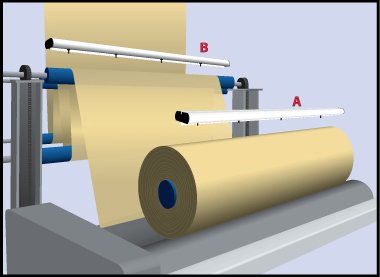
During the winding operation, as the web is pulled from the roll and the material separates, a static charge is created. This static attracts airborne dust and contaminates causing rejects, waste and operator shocks.
On both unwind and rewind applications, installing a static eliminator on top of the roll will neutralize the charge and prevent contamination and shock.

Blow Molding
As the plastic parison exits the die into the open mold, high static charges cause the parison to attract to the grounded metal mold. With multiple die heads the parisons will repel each other. This results in poor product quality and increased rejects.
Installing a static eliminator as the plastic is extruded and entering the mold (A) will neutralize the charge preventing quality failures. An eliminator at (B) eliminates static electricity from the molded container, preventing personnel shock and attraction of contaminants.

Film Extrusion
Static charges build up as the blown film cools and travels across rollers to the wind up, attracting dust and contaminants and causing operator shocks.
Static eliminators are recommended at the point of extrusion (A) and at the wind operation (B, C) to neutralize the charge. This will prevent slowdowns, rejects, and operator shocks and will improve product quality.

Injection Molding – Small, Lightweight Parts
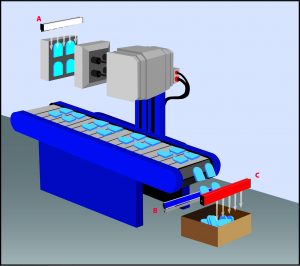
During injection molding of intricate, lightweight parts for the medical, pharmaceutical, and other industries, the presence of static electricity causes parts cling to mold ejectors or to the injection mold face during the open cycle of molding. Ideally the parts should drop freely from the mold ejectors down into a catch bin or tote. When static electricity is excessive and not controlled, the parts will not drop freely. This results in a loss of usable parts, clogging of ejectors, possible damage, downtime and a general slowdown of productivity, and loss of profit.
Installing high-performance static eliminating bar (A) at the mold effectively eliminates electrostatic charges on the parts, in turn allowing parts to fall freely into catch totes. In some cases, there is a further benefit to using air assisted static eliminators, as the air flow lightly directs the molded parts in their intended direction.
Static elimination may also be required on parts as they move via conveyor or accumulate in totes (B,C).
Packaging Applications with Model 400T Solutions
Form, Fill & Seal
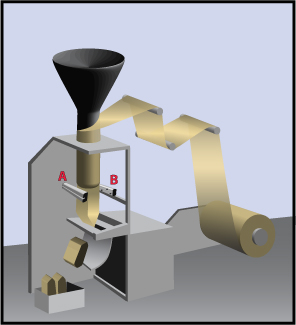
During vertical form, fill and seal operations, high static charges are generated as the film is unwound and travels over rollers. The static charge attracts particles from the filling products on to the film surface and in the seal area. This prevents proper sealing of the film, resulting in poor product quality.
Placing a static eliminator on both sides of the film before the sealing bar will neutralize the static and prevent dust attraction, allowing full sealing.
Overwrapping
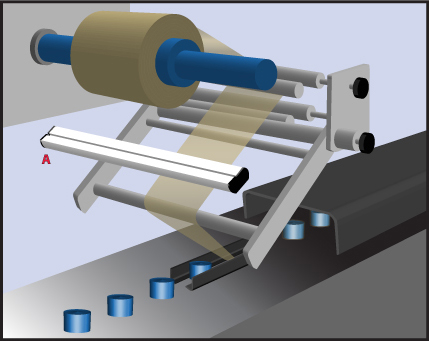
During the overwrapping process, the film is charged as it unwinds from the reel. This charge will attract airborne contamination onto the material and can also jam the machine as the charge becomes so high that it attracts to the machine rollers.
Installing a static eliminator at the unwind eliminates the static charge and prevents dirt and contaminates from attracting to the web, thus reducing waste and downtime while increasing productivity and profits.
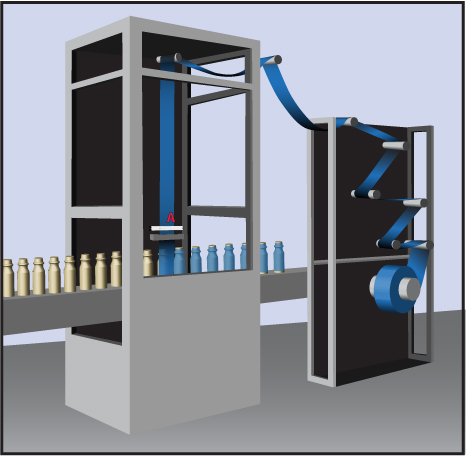
Tamper Proof Sleeving
During the sleeving or banding process, as the film unwinds and is opened to place on the bottle, static electricity is created. The static charge can cause the band to repel from the bottle or attract too quickly causing the band to be positioned incorrectly, resulting in jams, downtime and waste.
Installing a static eliminator prior to the fitting/cutting area will neutralize the charge and prevent bad positioning of the labels, reducing waste and increasing productivity.

Bag Wicket
High static charges can cause the bags to cling together or repel on the collated stack. As a result they stack poorly, decreasing production yields and increasing rejects. Installing static eliminators as the bag enters the wicket area, while on the wickets, and at the stack will ensure that the single bags and the collated stack are fully neutralized and stack properly.
Winding
During the winding operation, as the web is pulled from the roll and the material separates, a static charge is created. This static attracts airborne dust and contaminates causing rejects, waste and operator shocks.
On both unwind and rewind applications, installing a static eliminator on top of the roll will neutralize the charge and prevent contamination and shock.
Converting Applications with Model 400T Solutions
Sheeting
In high speed applications, such as sheeting, static is generated by the fast speed, the friction, and the separation. As the sheeting process takes place, the individual sheets are attracted to the machine and repel each other when stacking.
Installing a static eliminator above and right after the sheeting operation will neutralize the static and lead to good stacking, a reduction in jamming and down time and increase productivity.
Winding
During the winding operation, as the web is pulled from the roll and the material separates, a static charge is created. This static attracts airborne dust and contaminates causing rejects, waste and operator shocks.
On both unwind and rewind applications, installing a static eliminator on top of the roll will neutralize the charge and prevent contamination and shock.
Film Extrusion
Static charges build up as the blown film cools and travels across rollers to the wind up, attracting dust and contaminants and causing operator shocks.
Static eliminators are recommended at the point of extrusion (A) and at the wind operation (B, C) to neutralize the charge. This will prevent slowdowns, rejects, and operator shocks and will improve product quality.